Vinted


I left you two months ago facing a sort of avian apocalypse, as day-by-day a…what? A covey of pheasants? A bouquet? That’s what Google tells me is the most common term. A bouquet of pheasants, and it’s also pleasingly vinous in flavour. As day by day a bouquet of pheasants. No, bouquet doesn’t convey the sheer military shock and awe of the thing. A Blitzkrieg of pheasants laid progressive waste to row upon row of ripening bunches.
What happened next? More bird carnage, an experiment with a very noisy gas gun bird scarer (sorry, neighbours) and then harvest. Our first “commercial” harvest 3 years after planting, rather later than most nearby vineyards on the 19th October, just before the start of half term. Reprising the same enthusiastic crew who brought in the much smaller crop last year, only this time with those grapes destined for a proper winery and thence into bottles and out, in years to come, into the big wide retail world.
Was it a success? I think that depends on what counts as success. Quality or quantity. This was a harvest of high quality and paltry quantity. A potential success, then, for the future drinker. More on that below. But an objective failure for the profit and loss account.
It is a truth universally acknowledged, that owning a vineyard and cropping grapes will never put a man or woman in possession of a good fortune. Not even if he or she is the most productive cutting edge agriculturalist with national record yields and their own fully depreciated winery. Still, with reasonable production quantities, a decent price point and effective sales channels one can expect to cover costs and turn a small profit. But not if they bring in just 2 tonnes of grapes from over 5,000 vines.
This year has been a maths refresher for me. I’ve been reacquainted with the real meaning of multiplication and subtraction. Midway through veraison our winemaker, Bella, asked for an estimate of likely yield for each of the grape varieties. You’ll recall that we grow 3 different ones: Pinot Meunier, our most planted variety; Pinot Noir, our least planted; and the white Muscadet grape Melon de Bourgogne.
Estimating yield involves choosing a few randomised vines, counting the number of bunches on each, and then cutting and weighing some bunches. Multiply bunch weight by bunches per plant then multiply by number of vines, and you have your yield estimate. I hazarded some educated guesses, made more difficult by the fact this was my first year so I had no benchmarks against which to judge, and that both the bunch count and weight varied massively between vines.
Bella’s boss Henry is someone who measures his words judiciously. That’s particularly true of his emails, which often have something of the mildly disappointed schoolmaster about them. After I handed in my summer maths homework he reminded me that at those quantities I might not be able to vinify each of the varietals separately. But when I sent in the first of two sets of bunch samples, many weeks before I planned to harvest, it was I think with some effort that he resisted simply scrawling “please see me” on the email in red biro. Instead he stuck pithily to the facts: “Tiny bunches too”.

That’s the multiplication. In theory I should get at least 10 tonnes of grapes from my 4.5 planted acres. The average tonnage per acre in Britain is around 3. How I ended up with a paltry 2 tonnes from the whole vineyard is a tale of subtraction upon subtraction.
First, the reality we faced going into this year. Many of the vines are still immature. They copped some severe drought after planting in 2022, a lot of them were out-competed by weeds in the wet 2023 season as I sat recuperating at home from breaking five ribs, they had an attack of downy mildew in 2024, and have been undermined in many places by rabbit holes and badger setts. The nutrient situation is patchy too. I’ve mentioned before the relative deserts in the far field among the Meunier and at the top of the near field in the Melon. Pre-planting applications and regular foliar feeds haven’t been enough. This winter I’m getting some manure down. They say vines need to suffer a bit to produce the best wine. But not that much. So the vines started 2025 already behind where they might have been.
Soon after budburst we were hit by several days of frost. Nothing cataclysmic – it was a slow start to the season so the vines were only really vulnerable in May – but enough to frazzle plenty of shoots down at the bottom end of the slope. Let’s assume it shaved at least 20% off the potential crop.
Flowering was problem-free. The sun shone and the rain held off. The bunches set fruit evenly and tightly. But those bunches were, as Henry sighed when faced with that sample reading, tiny.
Then the birds came. How much did they take? At least a quarter, but perhaps as much as a third of the berries on the vineyard despite my having netted a decent chunk of it. The end rows and most of the vines along the top end of the slope near the woods were stripped bare. It’s no surprise the netted Pinot Noir yielded almost as much as the largely unprotected Meunier from half the number of vines. Subtraction upon subtraction.
But oh, the final blunder.
Harvest day dawned. I’d spent the day before collecting a rental tipper truck and some large Dolav crates, and then dismantling kilometres of bird netting. Sleeping in the site caravan overnight with a Pizza and a bottle of Nero D’Avola, waking early to the croaky sound of the Pheasants limbering up for another day of carnage, and dismantling kilometres more netting on the morning of picking.
I’d summoned that same crew of enthusiastic friends who’d whipped through the mini-harvest last time. Only I’d not done the maths had I? Fifteen civilians will make light work of a few hundred kilos of grapes. Even two tonnes is a somewhat different matter, particularly if you start at 11 after driving from London and it gets dark at 5. After a day racing against the clock, we had to give up 15 rows from the end.
No problem, surely? Just come back the following day and finish the job. That’s what any sensible person would do. But no, because I’m not sensible, I’d booked the family on flights to Morocco on Sunday. So in the end we had a little under a tonne of Pinot Noir, a little under a tonne of Pinot Meunier, and a soupcon of Melon B (we picked some leftovers three weeks later in November and it’s sitting in a demijohn at home as an unplanned batch of home-brewed, skin contact vendange tardive).
The day’s pickings all went into the crush together. That makes about 1,300 litres of juice. After fermentation and racking it’s closer to 1,100 of base wine. I’ll not be getting rich on this vintage.

That’s the bad news. The good news is the numbers that came back from the winery after crushing. They’re right in the goldilocks zone for English sparkling wine. Sugars at 17.6 Brix, Titratable Acidity at 10.9g per litre, and pH of 3. I’m excited to taste the base wine as soon as I get the chance. Then it’s a bit of time in tank, tirage and the second fermentation in bottle, lots and lots of time on the lees, and eventually what I suppose we should call an exclusive limited release of small-batch traditional method sparkling Blanc de Noirs, with a unique touch of Melon de Bourgogne.
More of the same next year please. Much more.
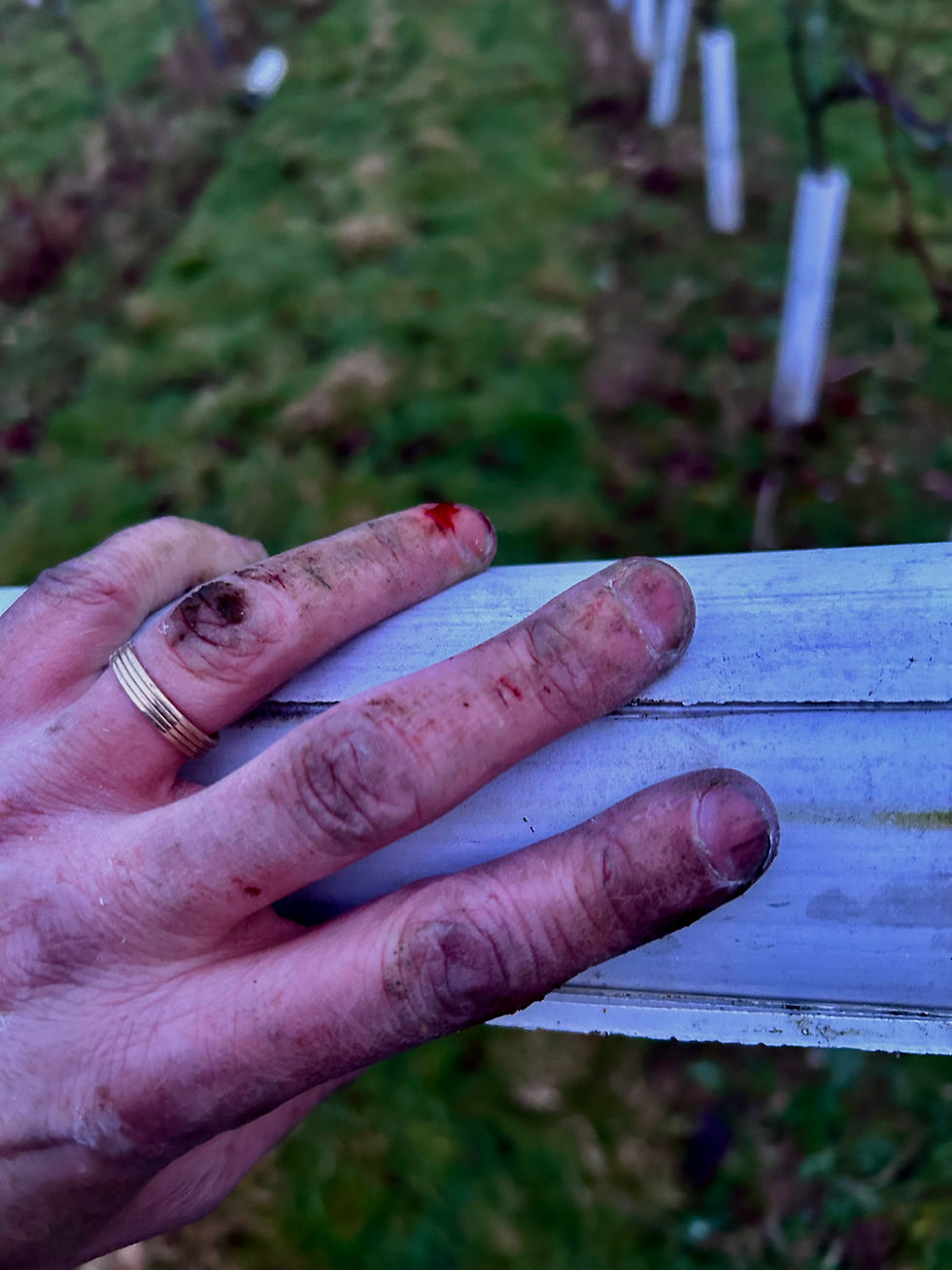


It’s a learning process, trouble is there seem to be new and different lessons every year. More netting and more pickers with more time this year. At least it’s a start, a first harvest that can actually be made into drinkable wine. Onwards and upwards.